|
Back to main blog 5. What impact did non-specialist teaching have on grade stability? This is one of the most interesting, and runs somewhat counter to what I was expecting. If we look at the correlation between departments with no non-specialists and result stability in 2018, we find that there is a slight disadvantage. There are of course many reasons which could account for this: the department might be very tightly run; the non-specialists may actually have taught for a long time; the specialists might have over-taught recycled content areas from old specs etc. It is also worth saying that only a handful of departments in the sample had non-specialists teaching at GCSE, and then in small numbers. A single positive result might therefore skew this data a lot. What is most interesting is where this is compared to 2017 vs 2016 grade stability. Here the impact of non-specialists seems to make results much more erratic. This may suggest that the new GCSE has levelled the playing field between specialists and non-specialists somewhat whilst expertise is rebuilt. Takeaway: This is hard to call, and I am not sure there are any lessons here. However, there is definitely need for some further investigation into the impact of non-specialist teaching on results. If the specialist teaching does not correlate to better outcomes, that seems like a worrying state of affairs.
Back to main blog Back to main blog 4. Was the A*-A / 9-7 rate affected? In this section I am comparing the percentage of departments where their A*-A / 9-7 pass rate remained stable in 2018 and 2017. This largely follows the pattern set for the 9-4 range. 2018 seems to have been much less variable than 2017. I also cut this down to look at differences between types of school where results were stable across 2016-17. There was not much of a story to tell here, with average ability departments seeing the most variation at the 9-7 level and lower ability centres the least. In all cases there was much less variability than seen in 2017. Takeaway: Departments do not seem to have suffered unduly in terms of the rate of Grade 9-7 passes when compared to 2017, and in fact the results are slightly more stable than previously.
Next question Back to main blog Back to main blog 3. What impact did exam question practise have on results? Another common question. Did centres who practised exam questions frequently do better in terms of grade stability? Short answer: not really, no. (I have taken the options here which had by far and away the most responses – 90% between them) When this was broken down to look at school type, the strongest correlation with improvement for lower attaining schools was to have exam question practise on a half-termly basis. Only practising during the final revision period in these schools however was by far and away the worst option. There was certainly no obvious benefit to weekly or fortnightly practise. Average and higher attaining schools showed almost no pattern when it came to frequency of practise.
Takeaway: Think carefully before bombarding your kids with loads and loads of exam practice questions – they may not really be helping. Sometimes grasping the content well, or doing something which builds confidence can be just as effective. Also, if you are musing over a 3 year KS4, spending the extra time on loads of exam practise does not seem to be a great driver. Next question Back to main blog Back to main blog 2. Did teaching a 2 or 3 year curriculum have the biggest impact on 2018 results? This is quite a tough one to answer and again, the results need to be taken with a pinch of salt. Here I have compared the basic stability of 2018 results vs 2017 by the number of years spent teaching the course. The result is that a 2 year curriculum seems to have offered more stable results. To see if this was related to school type, I decided to break this down further and look at the impact of 2 or 3 year GCSE based on the STABLE higher, middle and lower brackets identified previously. Interestingly lower ability students seemed to benefit from a 2 year curriculum, with average and higher ability students showing a normal distributions. The 3 year curriculum was much more divisive, showing a negative correlation in average ability schools, a neutral one in higher ability, and a very split picture in lower ability schools. When all schools are factored in (stable, rising and falling), the results suggest that in average and higher attaining schools, the 2-year KS4 curriculum offers a slightly more stable outcome. Whereas, in lower ability schools a 3-year KS4 curriculum shows a significantly negative impact (see below). Finally, I thought I would look at which specifications were most likely to be completed. Looking at this data, OCR B seemed to be completed most often and AQA the least, however there were few differences between the boards. The picture was slightly worse when 2 year KS4 was filtered for. Here the gaps between the big three at 100% and 90% completion were larger. Takeaway: Although there are many reasons why a 3 year KS4 may not have worked well this year, there is a strong correlation between worsening results and the three year KS4 in lower attaining departments. This is definitely something to consider. In other settings, the value of a 3 year KS4 currently seems questionable, though of course these is no way of knowing what impact keeping a 2 year KS4 would have had. If you are sticking with 2 years, you may want to look at your spec options, or how you are spacing out the content.
Next Question Back to main blog First of all, apologies for the enormous gap between these posts. I have been up to my eyes in school visits and preparations for the final stage of the PGCE. Today’s blog is part 4 of my series exploring how we might go about choosing the most suitable textbooks for our departments. In previous posts, I encouraged people to question the narratives being developed, and the overtness with which the contested nature of the narrative is presented. In my last post, I asked people to consider the range and depth of knowledge presented by a textbook. In this blog, I want to move onto a connected theme and ask how different textbooks help students to develop and deepen their knowledge of the history they study.
To teach from the textbook or not? Before we begin, I should probably say that I am generally of the opinion that a good history teacher uses a textbook as a tool. They know what they want students to understand and make use of the textbook as a resource to this end, deviating from it where the intended aims are not met by the author. It was a great tragedy that so many teachers during the 1990s and 2000s were told that to even see a textbook in a lesson was a sign of failure. I certainly understand therefore why there has been an enormous backlash against this anti-book culture which seems to pervade in many schools. Of course, I also know why so many people were wary of using textbooks which promoted a very particular kind of history, or which ignored large chunks of the wider world story. Sadly, I don’t have space for more on this debate here, but there are some interesting examples of how this debate has played out internationally too. [i] In my view, therefore, I tend to check over a textbook for the types of questions and activities it sets, however it is not usually the prime reason I would buy it or otherwise. To take a good example of this, I generally love the ‘Citizens’ Minds’ book by Longman, but I find some of the activities too detailed and time consuming to be practical in a normal history scheme of work. However, many recent voices on the issue of textbook use in schools, have suggested that the textbook should effectively be the progression model for students. This is coupled with the fact that there are large numbers of non-specialists teaching history. Addressing these perceived issues have been part of the drive for the ‘Knowing History’ series released by Robert Peal. Given that Peal is claiming so many other textbooks are “dreadful” at securing progression, it is crucial to consider the types of questions and activities contained within his books, but also those which are being labelled as failing. What are students asked to recall? One does not have to look far at the moment to see the influence of neuroscience on mainstream education. Courses are popping up all over the place explaining how we can “make history stick” or promote long term memory in history lessons. It is great to see the profession responding to more recent developments in theory, and I am sure that the new drive for higher quality CPD has had a big influence on this. Such CPD is often based around the work of a few “celebrity” neuroscientists such as Howard-Jones or Willingham. One of the major maxims which has come out of Willingham’s work is that recall and testing are a crucial part of the testing process.[ii] As such, it is worth exploring how often students are asked in textbooks to recall information they have seen in the text they have read. I am going to focus on the medieval life sections I used previously for this comparison, and focus on the knowledge students are asked to recall/extract from the text they have read. The double page spread from ‘Knowing History’ on the medieval village has 5 questions (as with every spread), whilst the sample section I used from the SHP book has around 10 mini-activities which get students to recall/extract in some way. If students were to complete the questions and activities in both books, this is the knowledge they might have recalled in the process: In my current blog series, I am exploring the kinds of questions a history department might want to ask before choosing a set of textbooks. In my first blog I explored the narrative structure of the book, and in my second I looked at how that narrative was conveyed. In this blog I intend to get to a central matter: which aspects of knowledge are developed.
In 2014, Tim Oates released a policy paper entitled ‘Why Textbooks Count’. In this paper, Oates criticised the state of textbook publication in the UK, particularly in light of the perceived failure of books to develop coherent curriculum knowledge. This theme was also picked up by Nick Gibb in his speech to the BESA Conference in 2015. I am not going to go into depth on the merits or demerits of Oates’ and Gibb’s analyses here (although if you are interested, Ed Podesta produced a great series on this HERE) largely because I believe there are some awful things being done in the name of making textbooks ‘accessible’. However, I do not subscribe to the bleak view outlined in Oates’ and Peal’s upcoming talk, that textbooks are dreadful because they are knowledge-light, magazine-like, and demeaning of the past. In this blog, I intend to directly address the content developed in various textbooks. I am including Peal’s series again here as it is one of the books which came out of Oates’ criticisms of books, and has been put forward as a solution to the problematic textbooks of old; a “renaissance of intellectually demanding and knowledge-rich textbooks in England's schools” as Gibb put it (Gibb in Oates, 2014).
Welcome to part 2 of my mini-series on choosing textbook resources for the history classroom. You can find the main landing page for this blog HERE.
In my last blog I was concerned with asking questions about the structure of narrative in a textbook and what narrative is developed. Today's focus is, in my opinion, just as important: Any good history textbook needs to acknowledge that that narrative it offers is contested. That is to say, the book needs to inform its readers that it provides ‘a narrative’ and not ‘The Narrative’, even if this is only in passing. This is particularly important if we see the role of a knowledge-rich curriculum as delivering social justice. This point was also made during the WLFS Conference, established to look at the importance of knowledge in the curriculum. From Christine Counsell at the beginning of the day, to Robert Tombs at the end, the point was made that we need to recognise that history is ultimately a matter of debate.
This is part 1 of my blog series on choosing good history textbooks. You can find the main page HERE.
One key aspect of a good history textbook or textbook series is the core narrative it develops. The best textbooks in my opinion have good extended prose, flow well, read aloud well, and have people's individual stories woven through them. A good textbook creates an engaging narrative which children enjoy engaging with. Over the last couple of years, Robert Peal has written a number of pieces criticising history textbooks for lacking clear narrative and for being broken down into tiny chunks. As a proponent of the Annales approach to history, I am also a great lover of overarching narratives, though I suspect somewhat different ones to Peal. The call for clear narrative was also an important message which came out of the West London Free School History Conference, held on 25 February 2017. Counsell for instance noted that having a good grounding in historical knowledge is an issue of social justice. She also referred back to her long-standing plea to think about the fingertip and residue knowledge we develop as part of our individual curricula. To an extent therefore I agree with Peal's point (though not his critique) that a good set of textbooks needs to have solid coverage of British history as an absolute minimum (what else should be covered is of course a matter for debate).
How well is the core narrative developed?
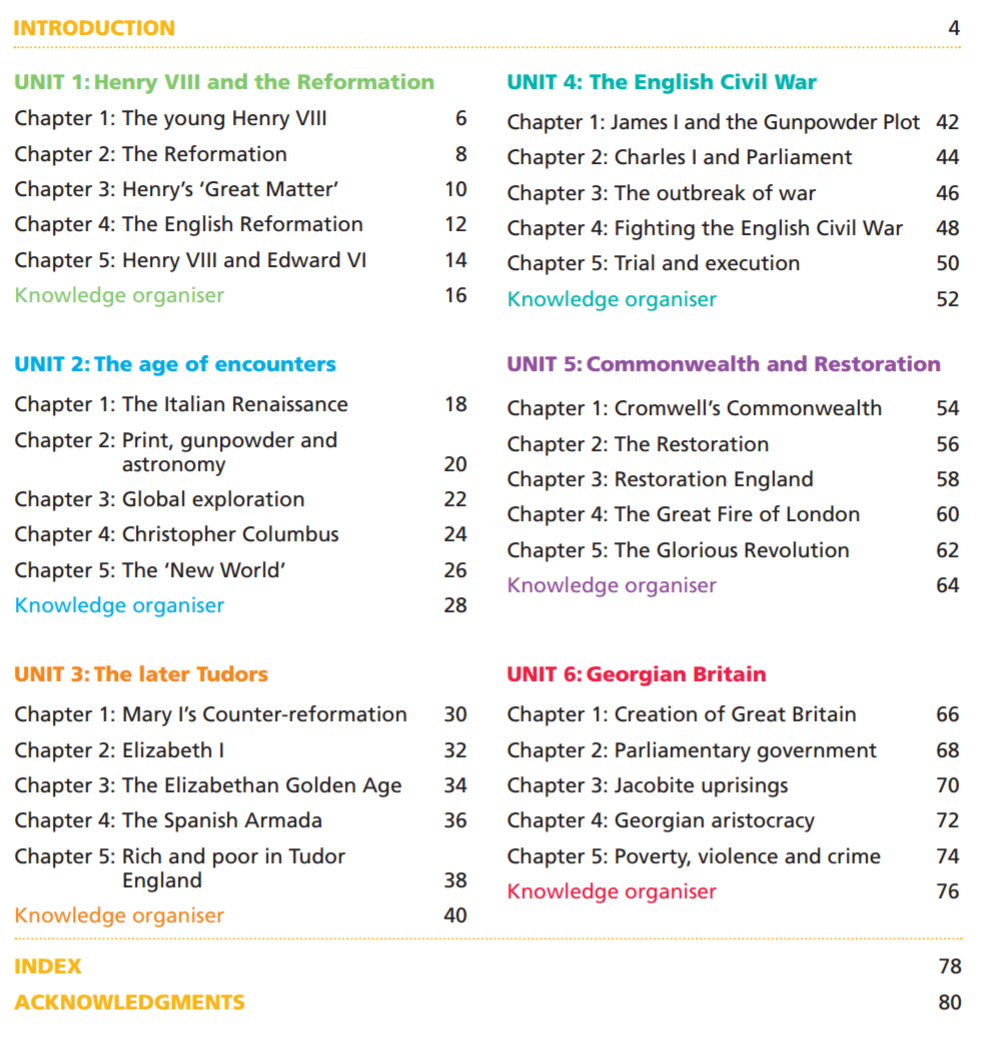
The first question I asked of the 'Knowing History' series was how well it developed the core narrative of the book. To do this, I looked at the second book in the series, which covers the period 1509-1760. A sample chapter of this book is available online via Collins. In terms of the text itself, it is well written and flows naturally within each chapter. The language used is also very ambitious, which is to be applauded. There is no shying away from terms such as “intercession” or “Indulgences”, again something I think more textbooks publishers should promote. Sadly however some terms are left for students to look up in the glossary, rather than having in-text or contextual explanations. I did experiment with reading the book aloud and found it to be passable. The story jumps around a bit in different sections, but there are certainly chapters which flow extremely well. There are also a range of stories woven into the text. Sadly, many of these seem to be from a very small and exclusive group at the top of society. Looking at the broader story, it is clear that Peal has adopted something of the “Grand Narrative” approach to the history of Britain, as you can see below from the chapter titles of the first two books:
Despite the good flow within chapters, the overall story feels somewhat stilted. In fact it feel like the book might fall into the trap of “stumbling from reign to reign [calling a halt] at each prince’s death” (Bloch, 1992, p. 146). The Reformation section provides a good example of this. We begin with Henry jousting and making peace with Francis I; diverge into the European Reformation; segue back into Henry VIII’s “great matter” of marriage and child bearing; before 300 or so words note that Henry broke with Rome, ostensibly to get power and remarry. None of this feels like a particularly detailed or cogent understanding of the major issues involved in the English Reformation.
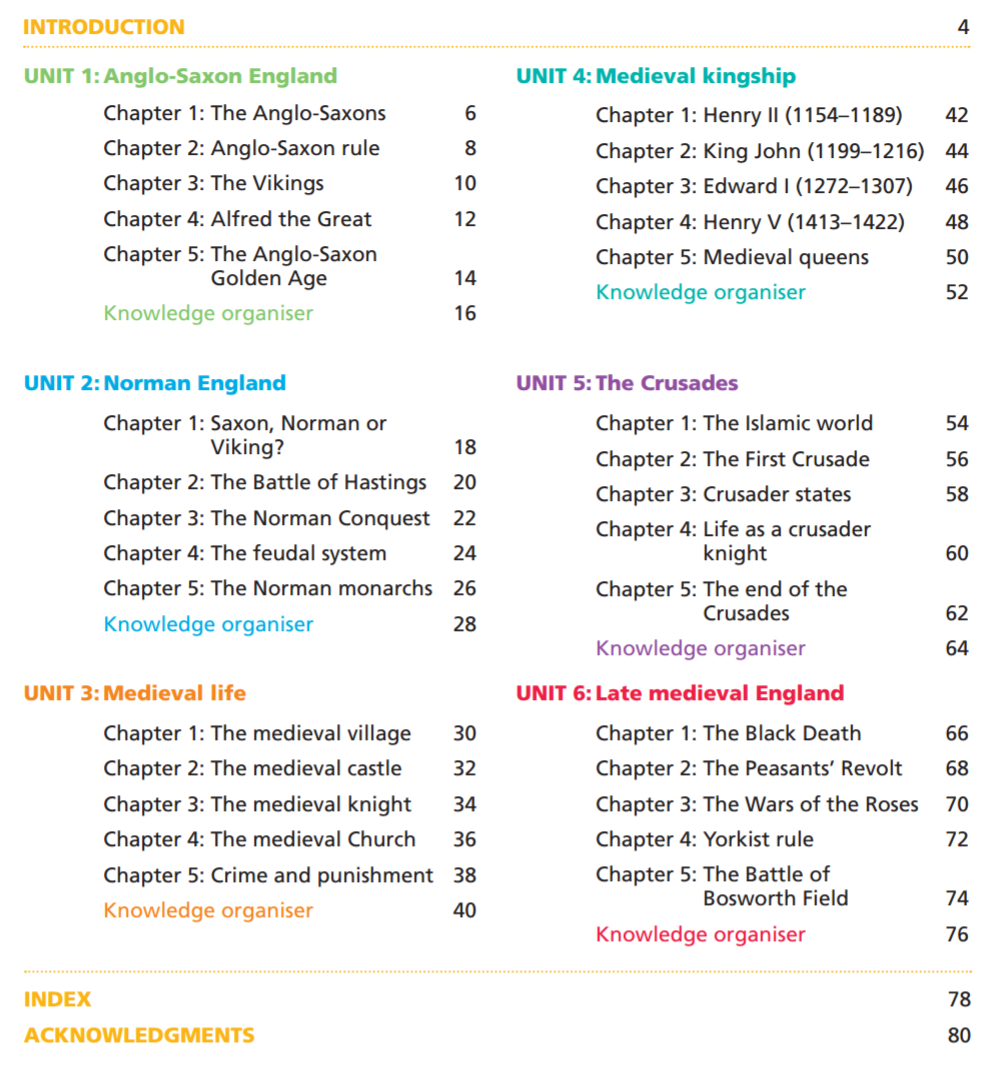
On the plus side, there does appear to be a good coverage of what might be termed the British (English?) 'historical canon'. Yet the first thing which really struck me is that this content list bears a striking similarity with the chapters of Sellar and Yeatman’s 1930 satire '1066 and all that'; the classic history text containing “All the history you can remember”. To take Sellar and Yeatman's section on Henry VIII as a comparison, we find:
Of course it could be said that 'social justice' sits at the heart of the curriculum design as it is so heavily influence by the Hirsch school of thinking; there is a focus on developing of 'cultural capital' from the outset. In the sample chapter from the Early Modern book, pupils are quickly acquainted with the Holy Roman Empire, the Field of the Cloth of Gold, Wolsey and his role as Henry VIII’s adviser, Martin Luther, Alexander VI and so on (although curiously Clement VII only ever appears as ”Clement” for some reason). Important for students to know? Certainly. But the best way for them to develop this knowledge? Debatable. Are there any narrative oversights? Another aspect I look for in a textbook series is what stories are not told (or in other words, what I will need to fill in using other resources). I don't have time to do this for the whole series, so I will just look at the Year 7 book. Comparing the 'Knowing History' series to the Year 7 SHP textbook being sold by Hodder, there are many areas of similarity, but also some real differences. Items missing from SHP book but in Peal: Viking invasion and settlement; Alfred the Great and the Danelaw; The Anglo-Saxon Golden Age; The names of Crusader states (oddly one of the few non-English aspects included); Eleanor of Aquitaine and Isabella of France; The Wars of the Roses Items missing from Peal's book but in SHP: Life in Iron Age Britain; Life in Roman Britain; Building of Roman Empire; Roman Army and their success; Changes in Britain from Iron Age to Normans; A study of soldiers who fought at Hastings; the cultural impact of the Norman Conquest; Life in medieval towns; The development of armour; The nature of medieval kingship; A study of Edward II and Richard II; Overview of all medieval rulers; Why people liked Robin Hood stories; A study of Shakespeare's interpretation of Agincourt; A detailed look at life in Baghdad; Late medieval exploration, early Renaissance, early medical Renaissance, political Renaissance, Reformation ideas, development of the printing press, The Dissolution of the monasteries; Henry VIII’s rule; A range of enquiries looking at evidence, significance, historical interpretation, and change and continuity. There are also smaller narrative oversights which are interesting. In the sample section of the Year 8 book for example, I found it strange that, in a book which is ostensibly about England, is that there is no real mention of English reformers whose actions arguably played a much bigger role in the Reformation in England than Calvin or Luther. There is no hint of Wycliffe, the Lollards, Ball, or the like. Why is this so important? Well, because it is key to understand that the Henrician Reformation was not a sudden break but part of a much longer process of agitation for reform. Rather than Henry leading his people into change, it could be argued that he followed them into it. Equally it is important to note that Luther and Calvin had a much greater impact on later dissenting groups, such as the Puritans. So this begs the question: why is it necessary for students to look at Calvin and Luther at this point in the curriculum? Certainly students are not asked to engage with their ideas, nor are they asked to draw on their knowledge to explore whether the criticisms the reformers made were valid or otherwise. And of course, with the English focus, students are also not asked to explain why there was a Reformation in Europe. Indeed, the Reformation is pinned to a single main event, the nailing of Luther’s theses to the door of Wittenberg Cathedral. I fear that the causation here remains implicit and might fall more comfortably under the heading of what Marc Bloch called “the obsession with origins” (Bloch, 1992, p. 24). However, as Bloch notes, this search for the roots of a phenomenon such as the English Reformation can often lead to ambiguity. In searching for origins are we seeking beginnings, or causes. He goes on to say that “in popular usage, an origin is a beginning which explains. Worse still, a beginning which is a complete explanation. There lies the ambiguity, and there the danger” (Bloch, 1992, p. 25). Here, Calvin and Luther appear both as origins of the English Reformation, and an explanation for it. There is no real critical engagement with the inevitability or otherwise of events which then transpired in England. We have an origin story which explains in totality. Summary Thus far we have looked at the importance of unpicking what narrative is provided in any textbook series and whether this contains any oversights. For me there are too many narrative oddities in Peal's book which would need plugging by other resources or teacher expertise. This is why I think it is so important that we ask these basic questions of any textbooks, from Aaron Wilkes to Ben Walsh. In my next blog I intend to focus further on choosing a textbook series by asking questions about the nature of the narratives developed in books. As ever, please feel free to leave comments below or via Twitter. Chapter 7: Improving formative assessments
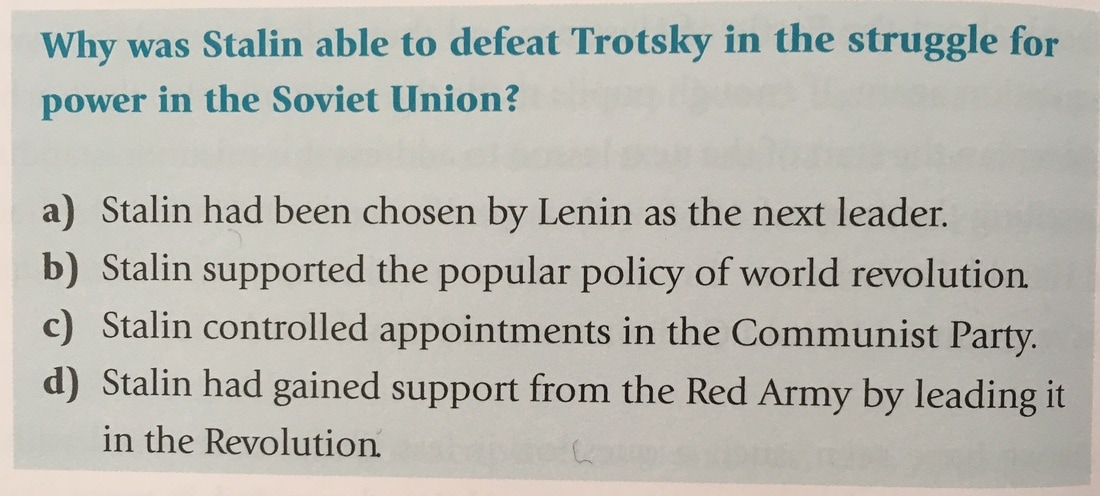
In chapter 7, Christodoulou sets out to suggest some practical approaches to formative assessment. She makes some useful points about the potential benefits of multiple choice questions and offers some helpful strategies to increase the rigour of these as an assessment tool. Whilst Christodoulou does make a good case for how multiple choice questions might be used productively in assessing history, I am not sure she does as much to balance this with their many limitations – especially when trying to build students towards tackling complex topics. Attempts to assess history completely through MC questions have already been made in the USA and have met with limited success, especially in helping students to transition towards deeper historical thinking. This is something which the Stanford SHEG project was set up to tackle. Whilst this approach to multiple choice questioning does have some advantages, it ironically downplays the role of knowledge in making some of the judgments and leads precisely back to that idea of over-testing which Christoudoulou criticised earlier in the book. That said, I do wish more history teachers would make careful use of MC. A good case is then made for frequent and repeated low-stakes testing in the classroom. Again, some examples of this working would have been helpful. Even then, as Dennis pointed out in his article in Teaching History 164, the results of low stakes testing are still tied very much to a Hisrschean interpretation of curriculum and need to be assessed in the context of other curriculum aims too. All of this aside, this feels like a useful chapter for trainee teachers to read. Chapter 8: Improving summative assessments Christodoulou returns at the opening of this chapter to a criticism of marking rubrics and descriptors. She notes the perverse incentives a rubric can create and the major issues with their reliability. Again, this is based on an assumption that our ultimate goal is to compare children across the board (in itself debatable). However, she raises some valid concerns which have plagued GCSE and A Level examinations for years (as well as earlier assessments). It was useful to see a clear explanation of the comparative judgment approach. This is something which may end up having real merit as we move more and more towards digital working. That said, comparative judgment relies upon a system of norm referencing in which there will always be winners and losers. There is no scenario in the use of comparative judgment where everyone can succeed, even if they meet what might be considered base criteria. Therefore, in a comparative judgement assessment on how to make a cup of tea, there would still be 50% of people falling below the mean, even if everyone was capable of the task. I also feel the idea of where “tacit knowledge” comes from is somewhat under-explored. Presumably this is based on a kind of internal rubric which is not standardisable. In order to mitigate for this, comparative judgments would need to be made by huge numbers of people. This might be possible at a national level, but possibly not in school. Equally it implies that a piece of work may receive an B grade because 10 people think it is a B grade. However, it might also get a B grade is 5 people thought it was worth a C and 5 an A. This is simplified but the essential point is a valid one I think. The final section on grading was quite a useful introduction to the conversion of pupil scores into grades and would make a good read for trainees again. Chapter 9: An integrated assessment system Chapter 9 contains some interesting reflections on how an integrated system of assessment and curriculum might be created. All of this relies on a set and standardised national curriculum however (which has its own issues). In some ways, one might argue that such a system partially exists where schools have bought into GCSE textbook schemes which come with diagnostic tests, exam papers, and allow teachers to access a national bank of resources. Still, there are some interesting implications here for how curriculum might be controlled an homogenised – whether this is a good thing, is another matter. Chapter 6: Life after levels
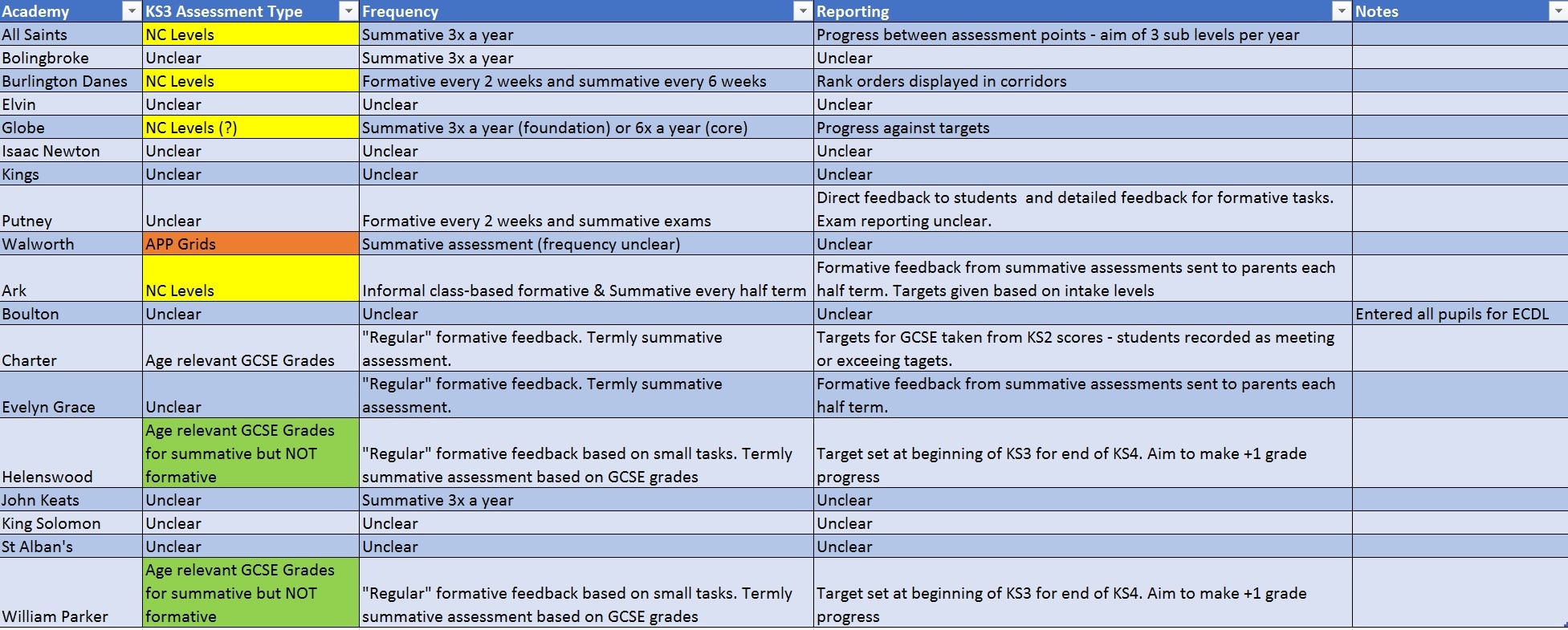
Ah, now we get to the one I have been waiting for. Life after levels has obsessed me since 2011 when I was allowed to start tinkering with the assessment systems in my department. Since then, I have spoken to hundreds of people on this same subject, even more so since the demise of levels in 2014. Yet when I give these talks, I always seem to meet the same resistance: a lack of support from senior leaders; a lack of time; a lack of expertise; a belief that levels work; a slavish adherence at school level to GCSE grades. I am fascinated to see what Christodoulou offers as suggestions therefore and whether these have any impact on the prevailing inertia amongst school leaders up and down the country. I was pleased to see Christodoulou put so much emphasis on the importance of a progression model and to highlight those same problems of resistance to change. Where I am more sceptical is her belief that the textbook can be a stand-in for a progression model. Whilst I am a big fan of textbooks, I am not sure that they can fully replace a department’s responsibility to consider progression for three main reasons:
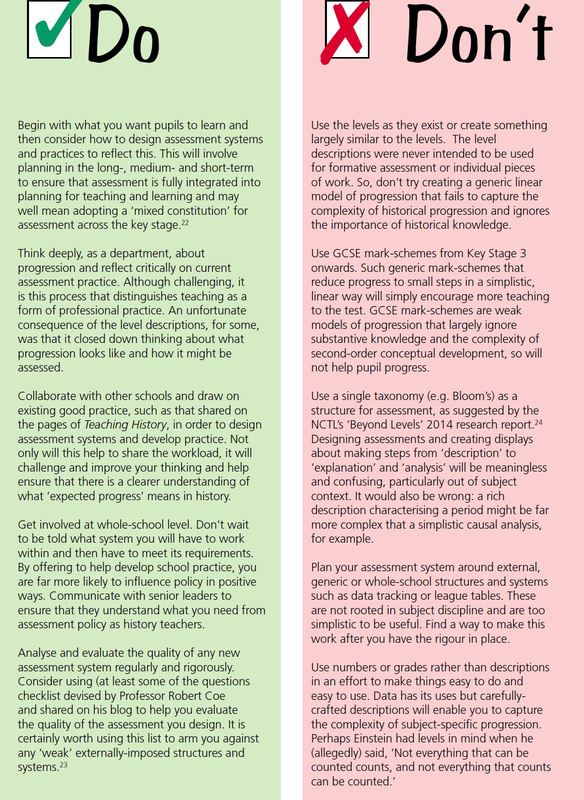
Beyond this point, Christodoulou makes some useful observations about the need for a clarity of purpose in a curriculum (though once again it is implied that all should see the same value in education if we are to follow a core curriculum set by a textbook). I was left less convinced however that there were any concrete proposals to work on. Perhaps this is because defining progression needs to happen at a subject-specific level; however I feel a few more links to useful models of progression (which are mentioned) would have been very helpful. The one model of progression which is explored in more depth is that connected with phonics. The links to Christodoulou’s suggestions are clear, but there are again aspects of control and power dynamics which are conveniently side-lined. When teachers decide which words to teach they are automatically applying judgements to them. When they allow someone else to make those judgments (as in a textbook) they are absolving themselves of responsibility for those choices and potentially reinforcing particular power structures. We may feel we are a long way from this in the liberal idyll of the C21st but this was very common practice in the 1930s and 40s as well as in oppressive regimes today. Above all, I think much of the work Christodoulou talks about here on progression already exists in the history teaching community. Indeed, there are even whole textbook series published by the SHP dedicated to making these progression models accessible to teachers and helping those same teachers to improve their expertise. Some further exploration of these texts would be particularly helpful for anyone interested in this area I feel. For those wanting a quick summary of Christodoulou’s main thrust here (especially in relation to history) it might be quicker to read Burnham & Brown’s one page “Do and Don’t” summary for life after levels (Teaching History 157, p.17) |
Key FilesArchives
November 2025
Categories |


RSS Feed